

How to Play Trombone: Frequently Asked Questions
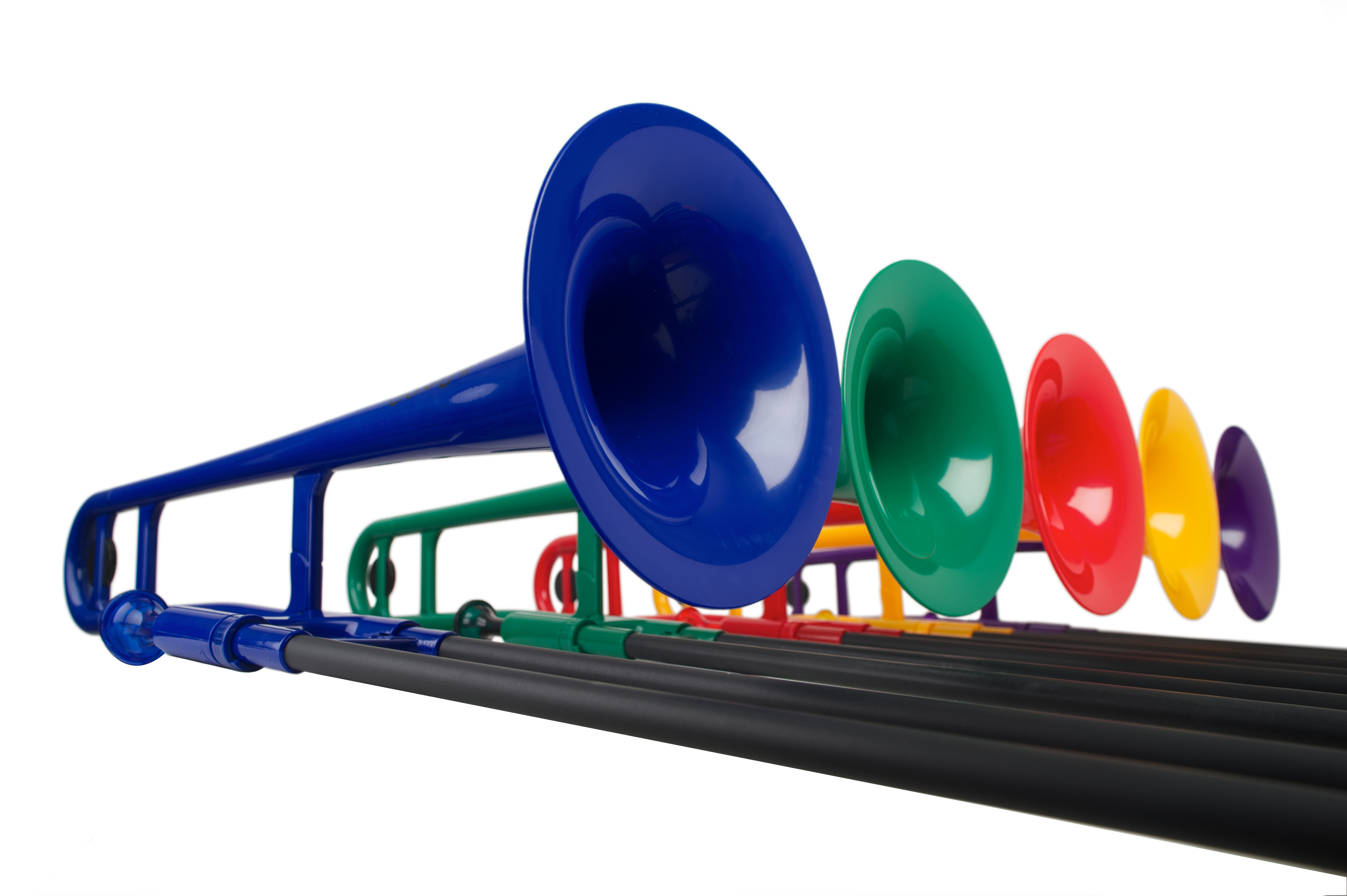
Being manufacturers of trombones as well as trumpets, cornets and pBuzzes, we get a fair few questions about how to play, and how to start learning - is it hard? Where do I start?!
Chris Fower, educational consultant and part of the team behind the pInstruments range, has an extensive musical career behind him. Chris combined a busy freelance performing career on the trombone alongside working in music education, primarily as a leading deliverer and trainer in informal, large group practice.
Here Chris shares his thoughts on some questions we've come across about playing the trombone...
Q: How do you play the trombone?
The trombone, like all instruments in the brass family, works by vibrating the air column inside the instrument by vibrating your lips together. To play the trombone, you have to learn how to make that vibration, and also the positions of the slide to lower the resulting sound. The best way to learn how to do this is to find a good teacher and take some lessons.
Q: How long will it take an adult to learn to play the trombone? Is it hard?
This depends on how much time you are prepared to dedicate to the instrument! The trombone, when approached by a good teacher, is a particularly natural instrument, very close to the human voice and singing in many ways.
It takes about 10,000 hours of authentic engagement to gain basic, professional competence; however, with a small amount of practice daily and some good quality lessons, an adult should be playing tunes and be able to join a beginner ensemble in a couple of months.
Q: How difficult is it to learn to play the trombone by yourself?
Of course, it is possible, and many great players have taught themselves in the past. With the internet, it is becoming easier and easier to learn anything, and you can learn to play the trombone on your own, but progress will nearly always be better, more sustainable and more secure with a good teacher.
Q: How do trombone players play the exact note they want? The slide looks so imprecise compared to, say, keys on a piano.
The trombone works just like the violin or cello in that the arm learns where to put the slide, mainly guided by the ear. A trombone player begins by thinking about seven simple positions for his or her slide, but as they become more expert, this is expanded to over 170 specific positions for various notes. This flexibility gives the trombone the unique position amongst brass instruments of always being able to play in tune...a double-edged sword!
Q: How do I arch my tongue to play higher notes on the trombone?
The most common advice is to visualise a vowel sound, such as 'eee', to arch the tongue whilst playing. Sometimes a teacher might add an articulation such as Tee or Dee. The most common set of vowel sounds used is low-Doo, medium-Daa, and High-Dee, although many variations and other concepts for helping the various registers of the trombone abound.
Q: How do you play high notes on trombone?
For higher notes, it is helpful to focus on the rapid movement of air through the lips, creating a fast, thin airstream. This is sometimes combined with the instruction to 'tighten' the lips, which is often unhelpful. Maintaining a small, round aperture between the lips for the air to pass through is usually more successful. Other advice is to visualise a vowel sound, such as eee, to arch the tongue whilst playing (as mentioned above).
Q: I play the horn well. Can I use a plastic trombone to learn trombone?
Sure! Why not try the pBone mini as a bridge between your horn and the tenor trombone?
Q: How do I play high notes loudly on the trombone?
Practice! It’s often best to approach a new high note quietly and let yourself work into it! If you dive straight into loud high notes there is a danger of creating a new “set-up” just for these notes instead of connecting them to the rest of your playing.
The most common advice for higher notes is to focus on the rapid movement of air through the lips, creating a fast, thin airstream. This is sometimes combined with the instruction to “tighten” the lips, which is often unhelpful. Maintaining a small, round aperture between the lips for the air to pass through is usually more successful. Other common advice is to visualise a vowel sound, such as "eee" to arch the tongue whilst playing.
Q: Is it possible to learn to play the trombone without making too much noise?
There are a few electronic mutes that allow you to practice “silently” with headphones. These work pretty well but it isn’t advisable to practice with a mute in all the times as this can distort the way you play away from a good technique.
Q: How do you decide what instrument to play?
Listen to lots of live and recorded music, talk to some good teachers and follow your heart!
Q: Can a trumpet player easily learn the trombone?
The trombone and trumpet seem similar at first glance but are literally worlds apart in brass-playing terms. Some amazing players can play both like Wycliffe Gordon and James Morrison!
For more information that may help you to start your musical journey on the trombone, you may find our how-to-play trombone page useful – we’ve included some basic terminology, a tuner app, and even some free sheet music!
You may also be interested to read our blog about Gavin, a young man who started his musical journey with one of our first ever pBones, and now plays Bass Trombone with the Junior Royal Northern College of Music.
